Luzzati Meets Calvino
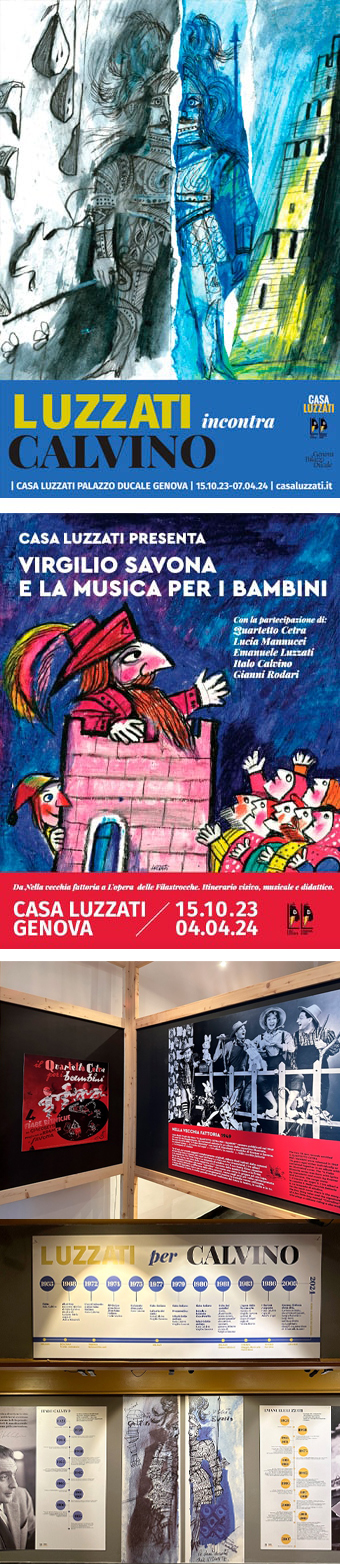
At Casa Luzzati—the institution entrusted with preserving the artist’s legacy and, since June 2021, one of Genoa’s leading cultural centres—this is more than an exhibition: it is a multidisciplinary project. Centred on two internationally acclaimed Ligurian masters, it brings together a series of events exploring the dialogue between the illustrations Emanuele (Lele) Luzzati created for Italo Calvino’s books and his distinctive representations of cities, particularly the series depicting “old” Genoa, produced between 1945 and 1950 and exhibited here for the first time. These works create a fascinating visual dialogue with Invisible Cities.
The section devoted to fairy tales presents the original illustrations Luzzati created during the 1970s for Calvino’s books published by Einaudi: The Green Bird (L’Uccel Belverde), first published in 1972 and later reprinted several times, including the English edition Italian Folk Tales (J. M. Dent & Sons, 1975), translated by Sylvia Mulcahy; The Crab Prince and Other Italian Folk Tales (Il Principe Granchio e altre fiabe italiane, 1974); and The Cloven Viscount (Il Visconte Dimezzato, 1975).
The exhibition brings into conversation the distinctive poetics of lightness shared by the two artists, pairing Calvino’s dreamlike imagination with Luzzati’s lyrical reflection on the contradictions of the world. Their relationship extended far beyond the meeting of image and word, developing into a profound intellectual and creative dialogue.
The exhibition also celebrates Liguria, the land that profoundly inspired both artists. Its landscapes, traditions, colours and stories became part of the international cultural imagination through their works. Both Ligurian, almost contemporaries—Luzzati born in 1921, Calvino in 1923—and equally eclectic, they explored the limitless possibilities of creativity in their respective fields. Their artistic paths converged most clearly in the allegorical and fairy-tale dimension that characterises much of Calvino’s writing, from The Cloven Viscount (1952) to The Baron in the Trees (1957) and The Nonexistent Knight (1959).
Luzzati himself described this shared bond with Liguria: “The Cloven Viscount was the first of Italo Calvino’s books that I illustrated. It is Ligurian, it belongs to my land. I feel a deep connection with that Ligurian hinterland, a truly extraordinary world. It is not the Liguria everyone knows for its rocky coastline, but a world of scents and flavours, which Calvino evokes in a remarkable way. I began by drawing the Viscount literally torn in two, to convey the idea of the divided Viscount. I played, just as Calvino played, because throughout his work there is a constant interplay between seriousness and poetry.”
The exhibition further explores Luzzati’s relationship with Calvino through lesser-known aspects of his artistic production, including record covers and booklets created for the Quartetto Cetra as a tribute to Virgilio Savona, continuing the celebrations dedicated to Vittorio Gassman’s centenary in 2022. It also features: - Luigi Berio’s animated film Genova, Symphony of the City (2005), inspired by Invisible Cities, with imagery based on Luzzati’s work and music by Stefano Cabrera; - a selection of original botanical watercolours recalling Luzzati’s friendship with Guglielmo Libereso, the celebrated gardener of Casa Calvino; - screenings of L’Isola Calvino, together with other films by Roberto Giannarelli featuring interviews with Renzo Piano, Libereso, Eugenio Scalfari and Italo Calvino himself.
Another section of the exhibition is dedicated to Luzzati’s original illustrations for Voltaire’s Candide, about which the artist remarked: “I chose to illustrate Voltaire’s Candide because it had always been one of my passions. There is something of Candide in The Cloven Viscount as well.”
The exhibition also presents playing cards and tarot cards, including a magnificent original design for a Teatro della Tosse production, together with Luzzati’s Marco Polo, first conceived as a television film for RAI, then adapted into a book and later transformed into a stage production for Teatro della Tosse.
The exhibition concludes with rare historical editions of Calvino’s books illustrated by other artists, including the 1972 edition of Marcovaldo illustrated by Sergio Tofano, on loan from the collections of the Museum Library of the Actor.
© 2026 Casa Luzzati - powered by pulsante - design paroledavendere