Saint Francis Invented the Nativity Scene
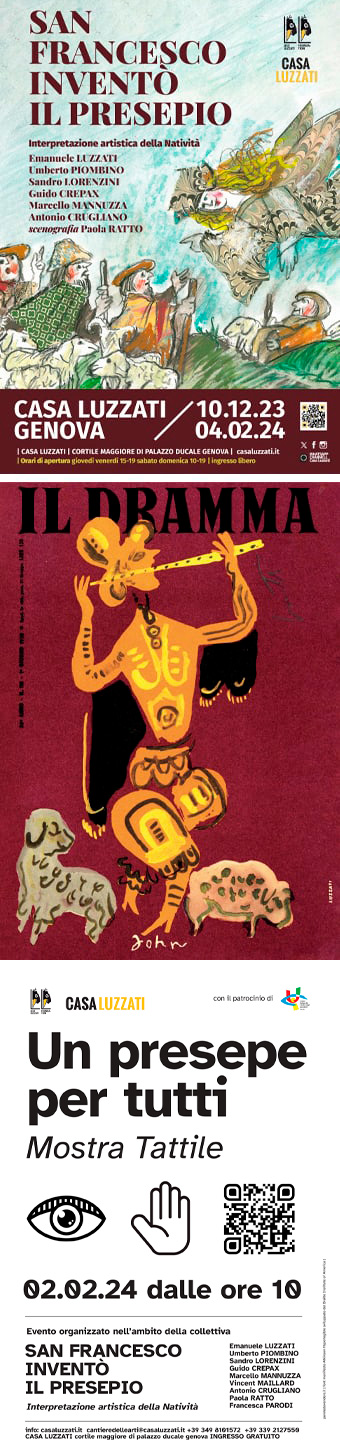
The exhibition Saint Francis Invented the Nativity Scene celebrates the 800th anniversary of the first Nativity scene, created at Greccio in 1223 at the wish of Saint Francis of Assisi. Through the artistic vision of Emanuele (Lele) Luzzati, the Lele Luzzati Foundation honours a centuries-old tradition while celebrating the universal values shared across different cultures. Luzzati often recalled: “I can say that I first discovered the world of the street Nativity scene every time I went to Naples, especially during the Christmas season. I would spend hours in Via San Gregorio Armeno, fascinated by the craftsmen painting figurines before my eyes, and I always returned home carrying little figures with me.” Presented in the Alfabeto Hall, the exhibition offers an original perspective on the artistic interpretation of the Nativity scene through works by leading artists including Lele Luzzati, Umberto Piombino, Sandro Lorenzini, Guido Crepax, Marcello Mannuzza, Vincent Maillard and Antonio Crugliano, whose tactile Nativity scene forms an important part of the exhibition. Painted canvases by Paola Ratto, inspired by Luzzati’s original drawings and sketches, provide the scenic backdrop, while Francesca Parodi’s painted textile work Genova recalls the frescoes of Gentile da Fabriano.
“The Nativity scene is made of the simplicity of popular theatre, but also of its inexhaustible magic.” — Lele Luzzati
The exhibition includes a selection of Luzzati’s works devoted to the Nativity, beginning with his sketches for Cantata dei Pastori by Andrea Perrucci, created for the 1950 supplement of the magazine Il Dramma. Also on display are images from Luzzati’s Nativity Scenes, documenting the large-scale installations created over the years for the city of Turin. A special tribute is dedicated to Umberto Piombino, featuring a Nativity scene made of sheet steel, produced for Italsider in the early 1960s. Also included is Sandro Lorenzini’s ceramic Nativity scene, winner of the First National Prize at the Città di Trento Nativity Exhibition in 1980. Courtesy of Carlo Savona, visitors can also discover the 1963 album Il mio presepio, recorded for Il Quartetto Cetra presenta IL MIO PRESEPIO, il presepio da costruire. Guido Crepax’s illustrations were originally conceived as a cut-out cardboard Nativity scene to be assembled by hand. Another section is dedicated to the original sketches for Cantata dei Pastori, performed for many years by Peppe Barra. The exhibition also features a series of life-size wooden figures from the Nativity scene created by Luzzati in 1995 for the Club Anni Trenta, inspired by comic-strip characters. Among the projects presented is The Returning Nativity Scene, a proposal for a future installation consisting of seventeen Nativity figures displayed on a floating platform at sea, based on an unpublished sketch by Luzzati and realised by Francesca Parodi. The project recalls the many Italians who emigrated overseas during the early twentieth century, carrying with them memories, traditions and a lasting emotional bond with their homeland.
The Nativity scene becomes a thread of memory connecting past and present. The Nativity belongs to everyone. For this reason, the exhibition also aims to raise awareness of accessibility for blind and visually impaired visitors. On 2 February 2024, Casa Luzzati hosted a special tactile tour of the exhibition. Every work has been installed to be explored by touch and is accompanied by a QR code providing an audio description, as well as Braille captionsproduced by the University of Genoa. The exhibition poster, designed by Paroledavendere, uses the Atkinson Hyperlegible typeface, developed by the Braille Institute of America to improve readability for people with low vision and dyslexia.
The exhibition is held under the patronage of the Italian Union of the Blind and Visually Impaired.
At Casa Luzzati until 4 February 2024.
© 2026 Casa Luzzati - powered by pulsante - design paroledavendere