Emanuele Luzzati was a set and costume designer, illustrator, writer, ceramist, decorator, and creator of animated films and theatre production
-
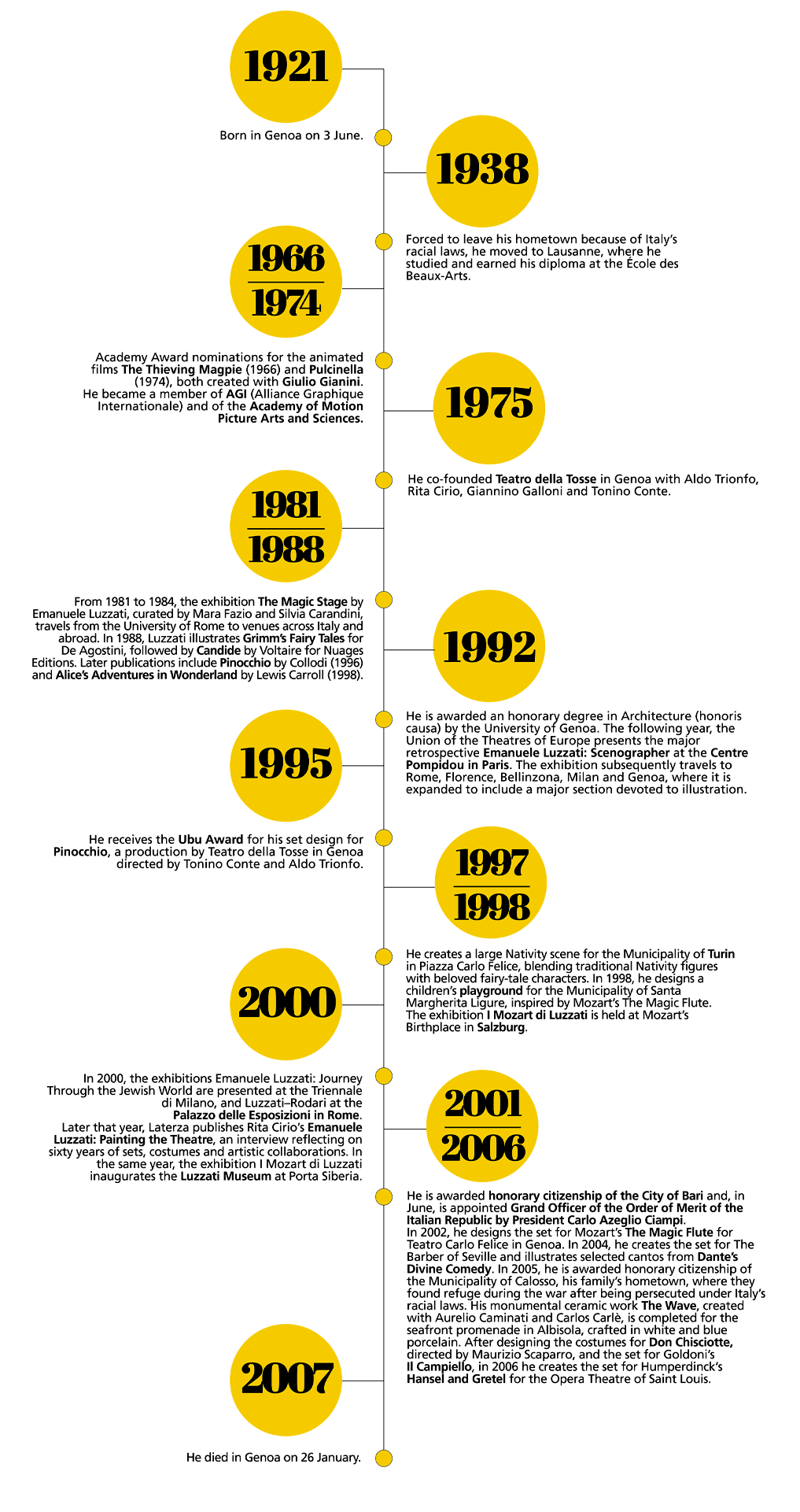
Emanuele Luzzati was born in Genoa on June 3, 1921.
He created more than five hundred sets for drama plays, opera and ballet for the main Italian and foreign theatres. He illustrated and wrote several children’s books and painted various panels, embossings and tapestries, working with architects on naval furnishings and for public premises.
In 1940 he was forced to leave his home city because of racial fascist laws. He moved to Lausanne, where he studied and graduated from the Ecole des Beaux Arts. The Maestro received two Oscar nominations for his animated films La gazza ladra (1966) and Pulcinella (1974), created with Giulio Gianini. He was appointed a member of the AGI (Alliance Graphique Internationale) and of the Academy of Motion Picture Arts and Sciences.
From 1981 to 1984, his exhibition entitled Il sipario magico di Emanuele Luzzati (The Magic Curtain of Emanuele Luzzati), organised by the University of Rome and curated by Mara Fazio and Silvia Carandini, toured Italy and abroad.
In 1988, he illustrated Le fiabe scelte by the Grimm’s brothers for Edizioni Olivetti, and later, for Edizioni Nuages, Candido by Voltaire. This was followed by other books: Collodi's Pinocchio (1996), Carroll's Alice in Wonderland (1998), Boccaccio's Decameron (2000-2002), Barrie's Peter Pan and Wendy (2004), Marco Polo's Il Milione (2005).
In March 1990, four different sections of a large exhibition dedicated to Luzzati's entire oeuvre opened in Reggio Emilia, Cavriago, Sant'Ilario, and Montecchio.
In 1992, he was awarded the honorary degree in Architecture by the University of Genoa, his home city.
The following year, the exhibition Emanuele Luzzati Scenografo was held at the Centre Georges Pompidou in Paris, organised by the Union of European Theatres. The event was then repeated in Rome, Florence, Bellinzona, Milan, Genoa and other locations, where the exhibition was enriched with a large section dedicated to his illustrations.
In November 1995, he received the Ubu Award for the set design of Pinocchio produced by the Teatro della Tosse in Genoa and staged together with Tonino Conte and Aldo Trionfo.
In 1997, he set up a large nativity scene for the City of Turin in Piazza Carlo Felice, mixing traditional characters with figures from the best-known fairy tales.
In 1998, he designed a children's playground for the Municipality of Santa Margherita Ligure, inspired by Mozart's Magic Flute. In Mozart's birthplace, Mozart’s Geburtshaus, in Salzburg, the exhibition I Mozart di Luzzati was set up.
In 2000, the following exhibitions were staged: Emanuele Luzzati. Viaggio nel Mondo Ebraico at the Palazzo della Triennale in Milan, and Luzzati-Rodari at the Palazzo delle Esposizioni in Rome. Edizioni Laterza published Rita Cirio's book Emanuele Luzzati dipingere il teatro, featuring an interview covering 60 years of stage sets, costumes, and encounters. In the same year, with the exhibition I Mozart di Luzzati, he opened his own permanent museum at Porta Siberia. The following exhibitions were held here: Luzzati incontra Rossini 1960-2001(2001), Emanuele Luzzati. La Fiaba (2002), Luzzati e le Ombre (2003), Emanuele Luzzati. Genova di tutta la vita (2004) and Luzzati e l’Opera lirica del ‘900 (2005).
In 2001, he was awarded honorary citizenship of the city of Bari and in June he was appointed “Grande Ufficiale della Repubblica” (Grand Officer of the Republic) by President Ciampi.
In 2002, he designed the sets for Mozart's The Magic Flute staged at the Carlo Felice Opera House in Genoa.
In 2004, he drew the illustrations for “Il Corriere della Sera” for the Canticles of Dante Alighieri's Divine Comedy. The Italian language version of The Magic Flute was published with Luzzati’s illustrations by Nugae, Genoa.
In 2005, Luzzati was awarded honorary citizenship of Calosso, his family's home town, where he took refuge during the Second World war to escape racial persecution.
His latest large ceramic work was created together with Aurelio Caminati and Carlos Carlè for the Albisola promenade: it is entitled Onda and is made in white and blue porcelain stoneware. After the costumes for Don Quixote, directed by Scaparro, and the sets for Goldoni's Il Campiello, in 2006 he designed the sets for Humperdinck's Hansel and Gretel for the Saint Louis Opera Theatre.
Luzzati died in Genoa on January 26, 2007.
Defying gravity
Renzo Piano
With Lele we were friends for a long time, we have shared many things. I'm not an art critic. My words are a personal recollection, my memories are linked to feelings of affection. With Lele we‘ve always been - how should I put it – in sync: I have always admired his ...read more >
Luzzati, an Art Elf in a fairy-tale
Matteo Fochessati
Lele Luzzati's illustrations for the covers of the Municipality's magazine “Genova” and for the theatrical periodical “Il Dramma”, edited by Luciano Ridenti, as well as his graphic projects for books and records are rooted in the lively research climate in post-war ...read more >
In misfortune, I was lucky
Goffredo Fofi
With his characteristic simplicity and frankness, Lele Luzzati recounts how he became a 'theatre painter' during the war years, starting with his exile in Lausanne. A forced exile following the racial fascist laws in November 1938. Born in Genoa in 1921, in love with his city, ...read more >
Freedom is having limits
Emanuele Luzzati
© 2026 Casa Luzzati - powered by pulsante - design paroledavendere